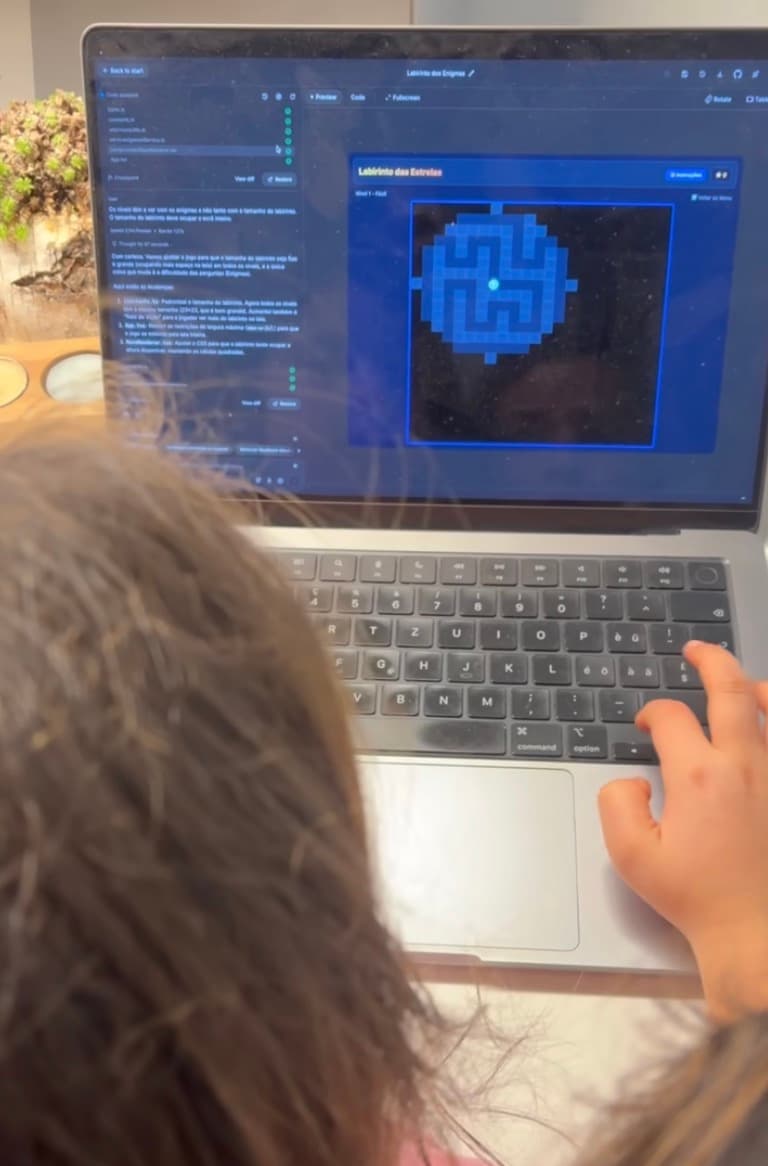
"Look, the game I did!"
My daughter was showing her quiz game to visiting family. She had built it herself: a game about different types of houses around the world, based on what she was learning at school. The igloos, the stilted houses of Southeast Asia, the adobe homes of the American Southwest. She was beaming.
She's nine. Her sister is seven. Neither can type well. Neither knows how to code. But over the past few months, they've built a maze game with three difficulty levels and quiz obstacles. A piano app where they learned to play Happy Birthday, then walked over to our real piano and played it themselves. A Tamagotchi-style avatar game. A drawing recognition game. A police-and-thieves game where you catch criminals by solving math problems.
They built all of these using voice, imagination, and AI coding agents.
This is a story about what that process looked like, what they actually learned, and the uncomfortable questions it raised about how we're preparing the next generation for a world where AI is not a tool they adopt, but a capability they're born with.
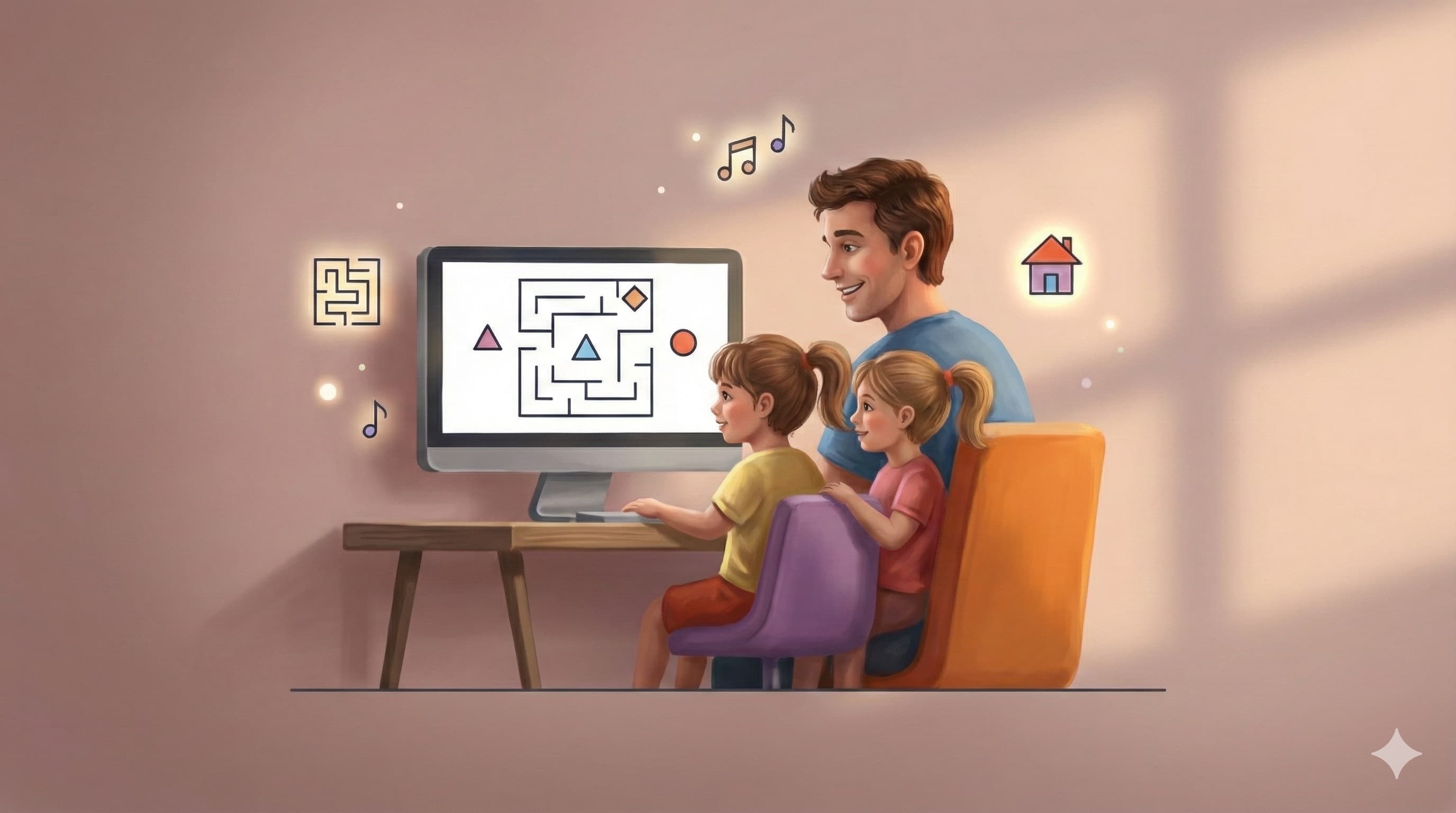
The experiment
The setup was simple. We used Wispr Flow for voice transcription. My daughters speak Portuguese, and they're still developing their written language skills. Voice let them express complex ideas without the friction of typing. We used various LLMs for brainstorming, and Google's AI Studio for building and deploying the actual apps.
The first challenge appeared immediately: the blank page problem.
"I don't know what to say."
That was my seven-year-old, staring at the screen. She wanted to build something, but the infinite possibility was paralyzing. This is where we discovered our first hack: don't start with the builder. Start with a brainstorming partner.
We'd open ChatGPT or Gemini and ask for game ideas. Some resonated; others didn't. The maze game came from this process. They latched onto it immediately. The piano app emerged when one daughter mentioned she wanted to learn music. The houses quiz happened because my older daughter was studying world geography at school and thought, unprompted, "I could make a game about this."
That moment, when school content became game content, was the first sign that something interesting was happening.
From "what do I build?" to "how do I say it?"
When we started playing with these tools, I noticed the biggest challenge for my kids wasn't the technology. It was transforming their thoughts into clear ideas that someone else, or an agent, could understand and act on.
Using voice transcription forced them to articulate what they wanted. When they were vague or unclear, the transcription would fail or the AI would misunderstand. "He doesn't understand me!" became a common frustration. But the problem wasn't the AI. It was the instruction.
They learned, through trial and error, that if you want something specific, you have to describe it specifically. The AI became a mirror for their communication skills. Short, unclear prompts produced short, unclear results. Detailed descriptions of what they imagined produced something closer to their vision.
This wasn't just a shortcut for kids who can't type well. It was a lesson in precision, in taking the fuzzy image in your head and translating it into words someone else (or something else) can act on. That's a skill that transfers far beyond game-building.
Then came the 80/20 wall.
Getting a game to 80% was surprisingly fast. The maze worked. The piano played notes. The quiz asked questions. But the remaining 20%, the polish, the edge cases, the details that make something feel complete: that's where things got hard.
When the AI drifted from their vision, when it didn't produce what they expected, motivation dropped. "I cannot do it!" Sometimes they'd iterate through the problem. Other times, they'd lose interest entirely. This is what I've started calling the Agentic Gap: the space where AI needs human persistence to cross the finish line, and humans need to care enough to provide it.
Some games made it through. The maze got three difficulty levels. The piano became good enough that they actually used it to learn music. Others stalled at "good enough to play with for ten minutes."
And then, the most delightful moment: "I just want to play. I don't want to keep developing it."
That's ownership. That's the shift from building to using. They'd made something real enough that they wanted to experience it as players, not creators. The piano app led to actual piano practice. The math-gates in the police game were my younger daughter's own homework, gamified.
The games my kids developed with AI coding agents
The agent-native generation
My daughters don't see AI as a "tool they use." They see it as a capability they have.
This became clear during a homework moment. I was helping with an assignment and couldn't remember something. Before I could reach for my phone, my daughter said: "Why don't you ask ChatGPT for that?"
For her, information isn't stored in Dad's head or on a bookshelf. It's an active query. This represents a fundamental shift in mental models, one that makes me both hopeful and uncomfortable.
Hopeful because of what I saw with the houses quiz. My daughter wasn't just memorizing facts about world housing for a test. She was teaching an AI agent how to build a game about them. That's active learning. To create a quiz, she had to understand the content well enough to structure questions, anticipate wrong answers, and explain why the right answer was right. The AI didn't replace her thinking. It demanded more of it.
And the deployment aspect matters. Using AI Studio, we could publish the games immediately. They could share them with friends, with family, with anyone. "Look, the game I did!" The pride was tangible. Traditional learning rarely provides that dopamine hit of creation and sharing.
But that ChatGPT homework moment also made me uncomfortable. Because there's a difference between using AI to amplify thinking and using AI to replace it.
The stakes: amplifier or crutch?
We're living in a bilingual household, Portuguese and French. My daughter recently encountered a French word she didn't know. My instinct was to tell her to look it up. Her instinct was to ask me to search for it.
I said no. I made her get the physical dictionary and find it herself.
This might seem contradictory. I'm letting my kids build games with AI but insisting they use a paper dictionary? But I think this tension is exactly what we need to navigate. Some foundations need to be built by hand. The muscle of looking something up, of navigating alphabetical order, of seeing adjacent words and understanding how language is organized: that's different from typing a query and getting an answer.
Ivo Bernardo recently wrote about what he calls "The Median Tragedy": the idea that AI is splitting the skill distribution. Those who use AI to augment their thinking compound their advantages. Those who use it to replace their thinking quietly atrophy. The middle is disappearing.
This framing haunts me when I watch my kids interact with these tools. The same AI that let my daughter build a game from her school lessons could, used differently, let her skip the learning entirely. The difference isn't the technology. It's whether they're driving or being driven.
When my daughter struggled to explain what she wanted to the AI and had to try again, she was driving. When she took school content and transformed it into a quiz, she was driving. When she iterated through three maze difficulty levels, she was driving.
When she says "just ask ChatGPT" for her homework, I'm less sure.
I don't have a clean answer here. Nobody does yet. We're all figuring out where the line is between AI as amplifier and AI as crutch, and that line is probably different for different skills, different ages, different contexts. But I've become convinced that the question matters enormously, and that we can't outsource the answer to the technology itself.
If you want to try this
For parents interested in exploring this with their own kids, here's what I learned:
Start with brainstorming, not building. The blank page is intimidating for kids. Use an LLM to generate game ideas first. Let them react to options rather than create from scratch. When something resonates, you'll see it immediately.
Use voice if they can't type well. Tools like Wispr Flow let kids express complex ideas without the friction of writing. The voice-to-prompt process also teaches communication skills. They learn quickly that vague instructions produce vague results.
Deploy something shareable. The pride of showing a working game to family is powerful. Google's AI Studio makes this easy. The games can be played immediately by anyone with a link. That "Look what I made!" moment matters more than polish.
Be present but let them drive. I couldn't leave my kids completely alone. They'd lose motivation or get stuck. But the goal was to guide, not control. When they got frustrated, I'd help them reframe the problem. When the AI drifted, I'd help them course-correct. But the ideas and the iterations came from them.
Connect it to what they're already learning. The most engaged my daughter ever was happened when she turned her school geography lesson into a game. Look for those connections. What are they curious about? What are they studying? Those make the best starting points.
Expect the 80/20 wall. Some games will get polished. Others will stall at "good enough." That's fine. The learning happens in the building, not just the finishing.
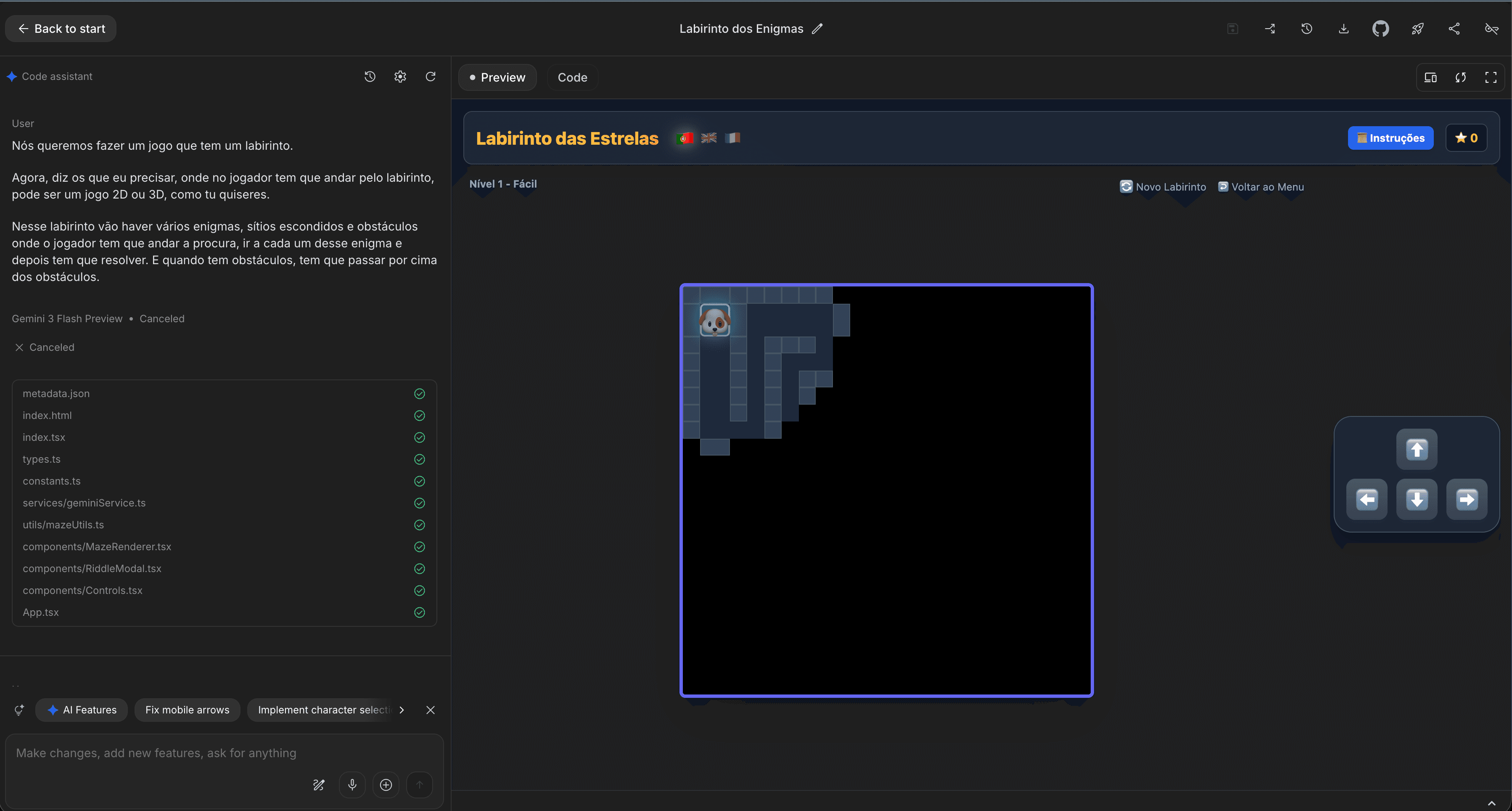
AI Studio where my kids developed their games
My daughters are starting their school life in a world where AI already exists. They're not adopting it; they're native to it. The ceiling of what they can create has changed fundamentally. Imagination, not technical skill, is now the primary constraint.
But the floor hasn't changed. They still need to learn to think, to articulate, to persist through difficulty, to understand why something works and not just that it works. AI can help with all of this, or it can quietly erode it.
The difference, I think, is whether we're intentional about it. Whether we guide them to use these tools to expand what they can do, rather than to shrink what they need to know.
For now, I'm choosing to let them build games and insist on the dictionary. To celebrate "Look, the game I did!" and to push back when the answer is "just ask ChatGPT." To be present while they drive.
It's messy. It's uncertain. But I think that's exactly where we need to be.