
"The code looks good. Security checks passed. QA verified the changes work. Here are the screenshots."
None of those messages came from a person. They came from three different AI agents, each reviewing the same set of changes, each with a completely different job.
A couple of weeks ago, I wrote about being afraid to let my AI agent code autonomously. That story ended with a clear gap: I was the only one testing and validating every change my agent made. The agent built. I reviewed. I tested. I approved. The bottleneck had shifted from building to reviewing.
That gap is closed now. But not in the way I expected.
Where I left off
Since that article, I kept building with OpenClaw. Not just on RackHour, but across multiple projects. The workflow was solid: I'd send a message on Telegram, OpenClaw would implement the feature, and a pull request would appear on GitHub. I'd test the preview deployment, approve, and it would go to production.
It worked. But the more projects I ran, the more pull requests piled up. Each one needed me to manually review the code, check for issues, and test every change. I was shipping faster than ever, but reviewing was becoming the new bottleneck.
A friend's suggestion
A friend changed my perspective. His argument was simple: in any software company, code doesn't go straight from a developer's keyboard to the live product. It goes through a process.
Think of it like publishing a magazine article. The writer drafts it. An editor reviews the quality of the writing. A fact-checker verifies the claims. Someone tests that the layout works. And the editor-in-chief gives the final green light before it goes to print. Nobody expects the writer to do all of those jobs.
In software, the equivalent looks like this: a developer writes the code, another developer reviews it for quality, a security specialist checks for vulnerabilities, and a tester verifies that the feature actually works as intended.
All of this review happens on something called a pull request. Think of it as a proposal: "Here's what I changed and why." Everyone on the team reviews that proposal, leaves their feedback right there, like comments on a shared document. When everyone approves, the changes go live.
My friend's point: "You should replicate this with your AI agents." Don't have one agent doing everything. Have a team. A developer agent, a reviewer agent, a security agent, a testing agent. Each with a specific focus.
Why would that work?
My immediate reaction: "It's the same AI model behind all of them. Why would splitting one agent into three make any difference?"
Think about it this way. If you ask a generalist consultant to review your business plan, they'll give you broad feedback. But if you ask an accountant to review the financials, a marketing expert to review the go-to-market, and a lawyer to review the legal structure, you get three very different, much deeper perspectives. Even if they all graduated from the same university. Specialization focuses attention.
The same applies to AI agents. When you tell an agent "you are a security auditor, your only job is to find vulnerabilities," it focuses its entire analysis on security. When a generalist agent is asked to "review this code," security is just one of many things it might or might not think about.
I was skeptical. But my friend's logic made enough sense to try. And trying is how the trust ladder works.
Building the team
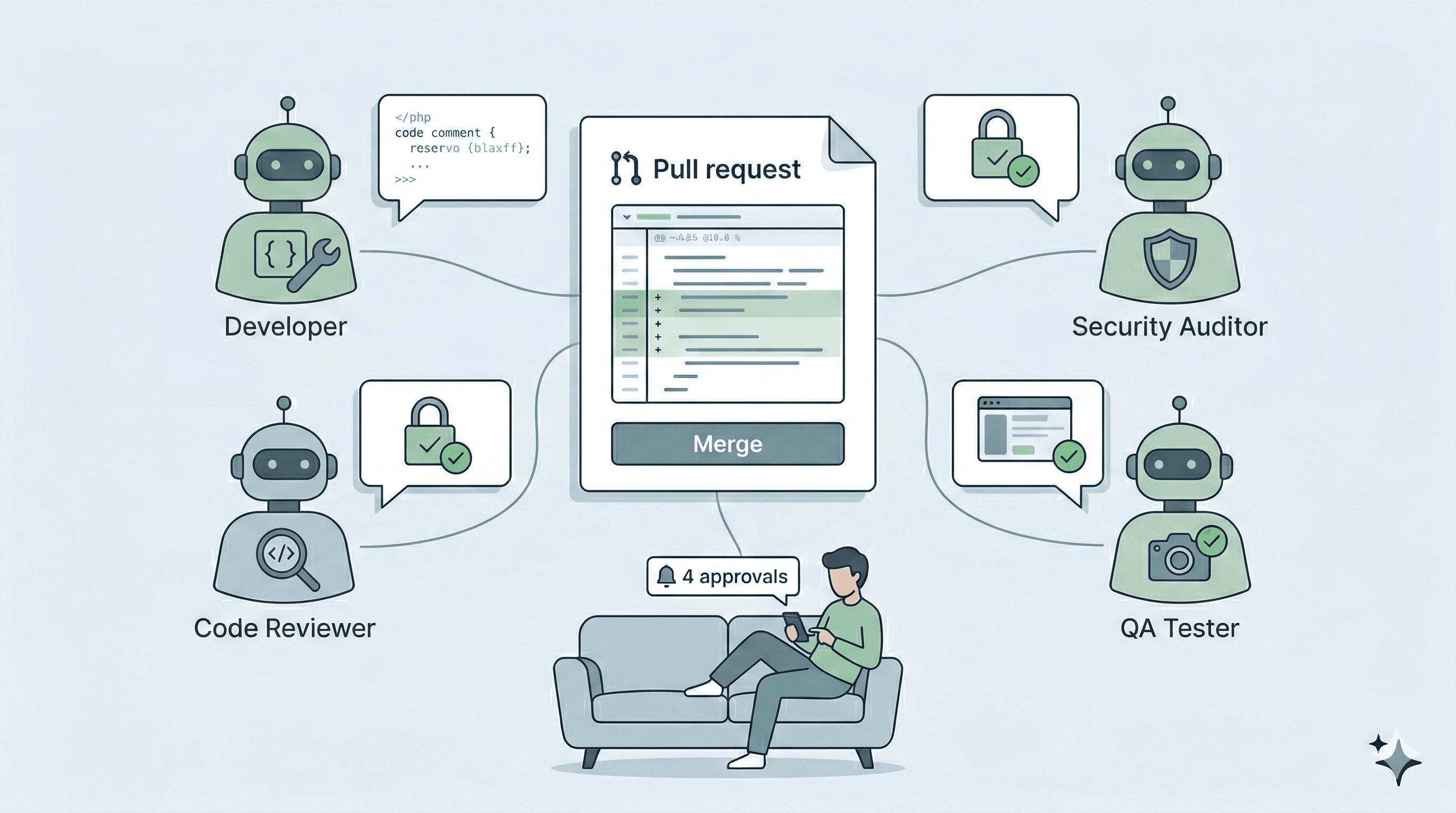
I told my OpenClaw assistant to start engaging multiple specialized agents for each development task. Here's the team I set up:
The Code Reviewer. After the developer agent creates a pull request, the code reviewer reads through every change, checks for best practices, and leaves detailed comments directly on the pull request. Like having an experienced colleague who reads every line you wrote and tells you what could be better. It comments, suggests improvements, and flags anything that looks off.
The Security Auditor. AI agents sometimes don't take security seriously enough. I wanted every change, even small ones, checked for potential vulnerabilities. The security auditor reviews the code specifically for security concerns: exposed credentials, unsafe data handling, anything a bad actor could exploit. It approves or rejects with a clear explanation, posted right on the pull request. Like a security guard who checks every door and window before you move in.
The QA Tester. This one changed everything. I have automatic deployments for every pull request, meaning a live preview of the changes exists at a specific URL before anything goes to production.
The QA tester opens this live preview, interacts with the changes the way a real user would, and validates that things work as expected. It takes screenshots as evidence and posts all of that to the pull request. It also reads the "how to test" instructions I include in the pull request description, so it knows exactly what to verify.
Like having a dedicated tester who actually uses the feature, photographs everything working (or not), and writes you a detailed report.
Seeing it in action
The first time the full team ran on a pull request, I didn't know what to expect. OpenClaw finished implementing a feature and created the pull request. Within minutes, three agents jumped in.
The code reviewer left comments about code quality and suggested improvements. The security auditor ran through the changes and flagged one potential concern while approving the rest. And then the QA tester opened the live preview, tested the feature, and posted screenshots showing exactly what it tested and what it found.
Code reviewer, security auditor, and QA tester all reviewing the same pull request
Before I even looked at the pull request, it had already been reviewed for quality, checked for security, and tested with visual proof. All I had to do was evaluate the evaluations.
What actually changed
Confidence. This was the biggest shift. Before, I was the only quality gate. If I missed something, nobody caught it. Now, by the time I open a pull request, three independent checks have already happened. I still test manually, but the baseline confidence is dramatically higher. I'm not starting from zero anymore.
Speed. The agents work in parallel. The code review, security check, and QA testing all happen before I even open the pull request. What used to be my biggest time sink, manually reviewing and testing each change, now starts automatically the moment the code is ready.
The real surprise: they catch different things. This was the answer to my original skepticism. The code reviewer spots patterns I might have overlooked. The security auditor flags concerns I wouldn't have thought to check. The QA tester sometimes tests edge cases I wouldn't have tried. Even though it's the same underlying AI model, the specialization genuinely changes what each agent pays attention to.
I still do my own testing. But now, when I test, I'm building on a foundation of evidence rather than starting from scratch.
The same lesson, repeated
I keep learning the same thing over and over. The trust ladder pattern keeps repeating itself.
With the first article, the lesson was: dare to let an AI agent write code for you. Then: dare to let it work autonomously. Now: dare to give the agent a team.
Each time, the pattern is the same. Skepticism first. A small experiment. It works better than expected. Confidence grows. Scope expands.
In a real software team, you don't have one person who writes, reviews, audits, and tests their own work. You have different people with different perspectives, each catching things the others miss. It turns out the same principle applies even when the "people" are AI agents running on the same model. Specialization works. Focused attention produces different, better results than general attention.
This isn't specific to OpenClaw, by the way. The same idea applies to any AI development tool: Claude Code, Codex, Cursor, or whatever comes next. The principle is the same. Give your agents roles. Give them focus. Let them check each other's work.
What's next
Right now, I review the agents' reviews. I look at the code review comments, the security assessment, the QA screenshots, and make the final call. The next step might be letting certain types of changes go through automatically if all agents approve. Small, low-risk changes that pass every check don't necessarily need me in the loop.
But that's a level of trust I haven't built yet. And I've learned not to rush it.
If you read the last article and thought "I'm not ready for that," here's what I've learned: you don't have to be ready. You just have to be curious enough to try the next small step. For me, that step was giving my agent teammates. The step after that? I'll tell you when I figure it out.
The trust keeps building, one team member at a time.