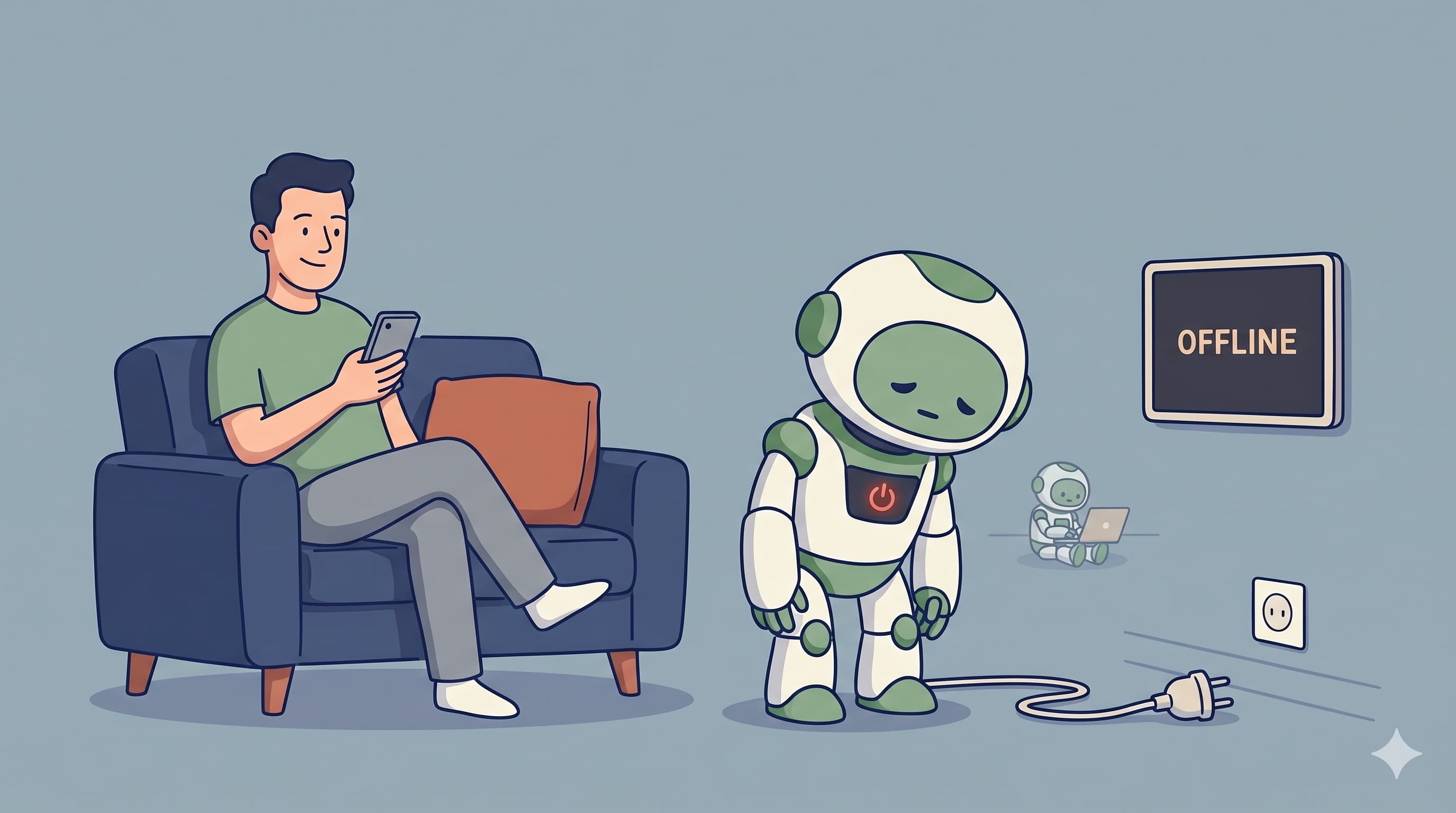
A few weeks ago, my OpenClaw instance stopped working from one day to the next. I expected to feel the loss immediately. I didn't. That surprise is the whole point of this article.
For context: I've spent the last few months building with AI agents as my daily driver. I wrote about setting up an agent team around OpenClaw, about learning to let it ship code autonomously, and more recently about running retros with my agents. OpenClaw was the center of that setup. Slack integration, persistent context, scheduled jobs, simply works.
Then it broke. And I didn't rebuild it.
What actually changed
Anthropic changed how external applications connect to Claude Code. Running Claude Code through OpenClaw now means spending extra API credits on top of my existing usage. I already pay for Claude. I already pay for Claude Code. Paying a third time to route between the two was the line I wasn't willing to cross.
So from one day to the next, my OpenClaw instance stopped being useful. No dramatic decision. No retro. It just went quiet.
I could have switched it back on with a different engine. I didn't. I wanted to see what would happen if I just let it stay off.
What I thought I would miss
Before the change, if you had asked me what OpenClaw did for me, I would have listed:
- Impromptu brainstorming from my phone. I bootstrapped Buildaloo this way. A voice message into Slack, OpenClaw opens Claude Code on the VPS, starts researching, comes back with a plan and a first draft. I could start a project from a dog walk.
- Weekly SEO automations. For RackHour and the CSRD Experts directory, I had OpenClaw set up to write two or three blog posts a week and open PRs for me to review. Running while I slept.
- Personal alerts and assistant-style notifications. Small jobs. Reminders with context. Pulling things off the internet and pinging me on a regular cadence. Things my calendar doesn't do well.
I was sure the first category was what I would miss most. Coding without friction, from anywhere, with research and thinking baked in.
What I actually missed
The answer turned out to be different.
The SEO automation is what I miss the most, and I miss it in a concrete way. RackHour and the CSRD Experts directory are already showing SEO results from those auto-generated posts. That pipeline stopped. I haven't replaced it. Because neither is my current focus, I haven't set up a new Claude Code based workflow to fill the gap. The signal is clear: the automations I wasn't paying attention to were the ones doing the most useful work.
The impromptu coding bootstraps, I barely miss. I thought this would be the painful part. It isn't. When I want to bootstrap something properly, I sit down at a laptop. Buildaloo is my main project. I'm not bootstrapping a new side project every week. The "start anything from anywhere" capability was impressive, but I was using it less than I told myself I was.
The personal alerts and notifications, I don't miss at all. I think this says more about the setup than the concept. I never got those fully dialled in. They were always "nice to have" rather than load-bearing.
Put those three together and the honest conclusion is uncomfortable: the piece I expected to miss most was mostly theatre. The piece I took for granted was the one quietly compounding.
Why this was still a loss
None of this means OpenClaw was the wrong bet. The concept is right. The utility is real. I still believe a persistent, messaging-connected, memory-carrying agent is closer to how we'll actually work with AI than any current chat interface.
What I ran into is a product-market reality, not a concept failure. Running Claude Code through an external orchestrator costs more than running it natively. Anthropic, understandably, wants you to use their tools end to end. The economics stop making sense.
And the second reality: Anthropic is building toward the same vision OpenClaw represents, from the other direction.
Two weeks ago, Pedro wrote about Claude getting closer to a real agent: Scheduled Tasks, Dispatch, Skills, Connectors, Claude Computer. They're shipping at a pace that looks chaotic when you watch it week by week. Step back, and it's not chaotic at all. They're building a personal assistant. Piece by piece.
Is it as good as OpenClaw was at its peak? No. OpenClaw had deeper memory, real messaging presence, and the kind of autonomy that only comes from something running on hardware you own. The current Claude stack is catching up, not ahead.
But it's catching up. And it runs on the subscription I already pay for.
The real question this raised
If I'm being honest, the most useful thing the shutdown forced me to answer is this: what do I actually want my AI to do for me, operationally?
Not "what's cool to show other people." Not "what impresses on Twitter." What is the actual set of tasks, happening on a real cadence, that I want an agent handling without me?
Right now, while I'm heads-down on Buildaloo, the honest answer is a short list. Some content automation. Some research workflows. A handful of alerts. Things I can rebuild natively when I need them, rather than maintaining a whole parallel infrastructure.
When Buildaloo is further along and my operational surface is bigger, that answer will change. I'll want a real chief of staff, not a clever personal assistant. Someone who knows the company, the customers, the state of the product, the commitments I've made. That's a different build.
The map, as it stands for me now
If I had to describe my current setup:
- Claude Code for focused development work, at the desk.
- Conductor for parallel work, orchestrating multiple Claude Code agents across branches.
- Claude Desktop and the mobile app for ad-hoc thinking, brainstorming, and light assistant duties.
- Claude Code Routines for the automations I still need — though I'm still bootstrapping it.
- Nothing permanent sitting in Slack or on a VPS right now.
That last line is the one I wouldn't have expected to write six months ago. And it's fine. For now.
The honest conclusion
OpenClaw was ahead of the curve. That's a real thing to be. It's also a hard place to stay, because the curve catches up. The shutdown forced me to stop paying for a layer I was partly using out of sunk cost, and it made me see what I was actually using versus what I had built because I could.
I'll build on top of a personal AI stack again. Probably soon. But the next version will start from the question of what I'm running, not what's possible to run.
If you're running your own OpenClaw setup today, my suggestion is simple. Don't wait for something to break to ask what you'd actually miss. Turn off one piece for a week. See if you notice. The answer will tell you what to keep, what to move, and what you never really needed.